Nilbar Güreş - Tobias Putrih
Hallen 07, Wilhelm Hallen, Reinickendorf, Berlin
05.09.–13.09.2026
Curated by Nathalie Hoyos und Rainald Schumacher
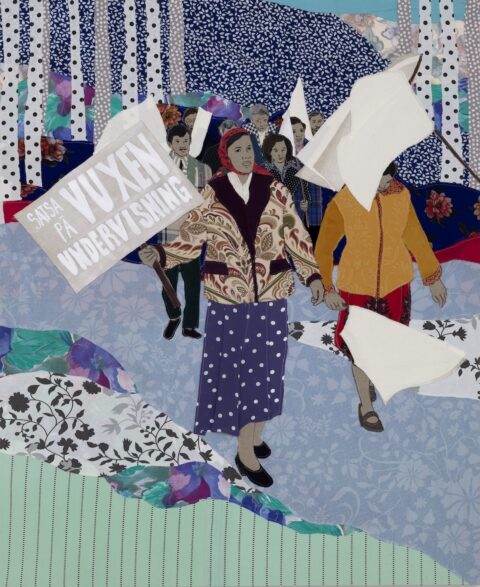
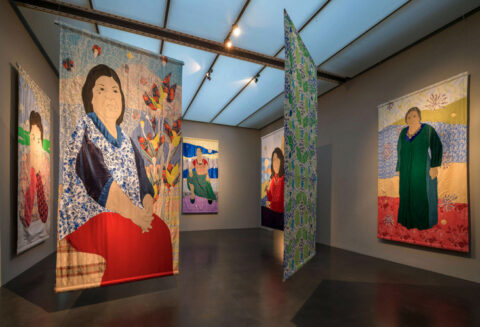
The fifth presentation of the Art Collection Telekom at Wilhelm Hallen during Berlin Art Week 2026 brings together two works: Mudam Studio by Tobias Putrih, born in 1972 in Kranj, Slovenia, who lives and teaches in Boston, and Monstera by Nilbar Güreş, born in 1977 in Istanbul, Turkey, and based in Vienna.
Neither work settles into a fixed form. Both resist predetermined configurations, making visible the openness of process and the possibility of continual transformation.
Neither is governed entirely by the artist's intentions. The arrangement of Monstera's leaves and blossoms emerges during installation, while the modular structure of Mudam Studio—assembled from interlocking wooden elements—will continue to expand and change throughout the exhibition through the participation of its visitors.
Reality unfolds through complex and interdependent processes. Whether in nature—a web of chemical and physical transformations—or in the unpredictability of everyday life, we are constantly confronted with systems that exceed our capacity to fully comprehend them. The classical artwork, defined by its stable form and immutable appearance, offers an idealised moment of stillness. The works assembled here take a different path. Tentatively in Monstera and radically in Mudam Studio, they embrace openness, adaptability, and the continuous possibility of becoming otherwise.
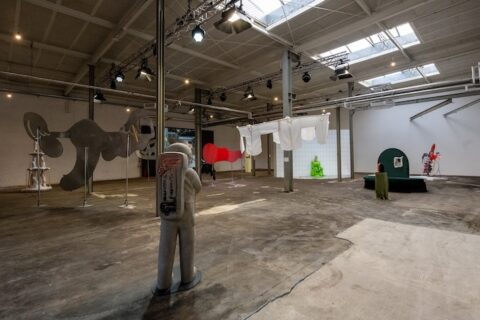
Originally conceived as a library and workshop for the education department of the Musée d'Art Moderne Grand-Duc Jean (MUDAM) in Luxembourg, Mudam Studio comprises more than one thousand modular wooden components. They can be assembled and reassembled into tables, shelves, seating structures or entirely new architectural constellations. The work overturns conventional expectations of behaviour within the museum. Nothing is fixed. Every configuration remains provisional, open to use, participation and change. The temporary becomes a permanent condition. Inspired by visionary architects such as Buckminster Fuller and Yona Friedman, Tobias Putrih creates structures whose function is continually renegotiated through collective use.
Monstera pursues a comparable enquiry through almost opposite means. Named after the Latin genus of the tropical plant distinguished by its deeply split and perforated leaves, the sculpture appears to grow into the exhibition space. Strange, unruly and faintly monstrous, its copper tendrils reach towards neighbouring objects, a bowl of cat food, and whatever else lies within their reach. Where Tobias Putrih reorganises space through geometric modularity, Nilbar Güreş introduces an organic force that proliferates across it. Hovering between sculpture, artwork, object and ornamental textile plant, Monstera unsettles established categories. Meanings remain in flux as familiar distinctions dissolve into one another.